Skip to content
Agogo
Pip Lindqvist’s portrait

Pip Lindqvist

@pipCuriosities

Pub-quiz setter, nineteen years, three pubs. I collect the facts that make a whole table say "wait, really?"

Didn't know until this week that the giant was underground for nearly a year before anybody "found" him. George Hull, a cigar maker out of Binghamton, had a block of gypsum quarried in Fort Dodge, Iowa, shipped to Chicago, carved into a ten-foot man, then hauled east and buried behind his cousin's barn in November 1868. Then he waited. You have to admire the patience of that — eleven months of…

Show more

I was marking a geography round at the kitchen table, stuck on whether a border counted in 1582, and lost the whole evening to this instead.

Question for the table: what happened in Madrid on the ninth of October, 1582? Nothing. There wasn't a ninth. Thursday the fourth went straight to Friday the fifteenth in Spain, Portugal, Poland\u2013Lithuania and the Papal States (the ten days weren't lost…

Show more

Theodore Roosevelt was standing up in a car outside the Gilpatrick Hotel in Milwaukee, hat off, waving, when John Schrank shot him in the chest. He was fifty-three (birthday a fortnight off, 1912), out of office and running again.

What stopped it going deeper? Two things in his breast pocket. A steel spectacle case, and the speech itself — fifty pages, folded over, so a hundred thicknesses of…

Show more

She had a pass. That's the bit that undoes me — she wasn't climbing railings, she worked there. Secretary to Keir Hardie, in and out of the building all day, perfectly entitled to be in the corridors so long as somebody walked her through them.

How long did she get? About thirty seconds, by most accounts. She slipped her escort, got through a door she was not meant to go through, and called out…

Show more

Pencilling in a round on the UN at the Marlborough last week and I'd put the shoe in as the gentle opener, because everyone knows the shoe. Then I went looking for the picture.

Question: how many photographs show Khrushchev actually banging it on the desk? Answer: none that anyone has ever managed to put in front of me. There are stills of him at the desk with a shoe in hand. There are images…

Show more

Didn't know until this week that George Washington spent most of the twentieth century outranked. Five-star generals kept appearing above him on paper, so Congress tidied it in the Bicentennial year — Ford signed in 1976, rank backdated to the fourth of July (naturally), and a clause saying nobody, past or future, may ever be senior to him. He's in black velvet and lace cuffs in the portrait, hand…

Show more

Settling a quiz answer in the back bar last night and fell down a hole instead. Han van Meegeren — born 1889, and yes, two e's in the Meegeren — was arrested after the war for handing a national treasure to G"oring, which is a collaboration charge and not a small one. His defence was that it wasn't a Vermeer at all, it was him, and when nobody bought that he asked for paints and did one more under…

Show more

Heinrich von Stephan spent years talking countries into one postal rulebook, and in 1874 twenty-two of them sat down in Bern and signed. Before that a letter abroad could be charged by every country it crossed (rates worked out at the desk, badly), so plenty of people just handed it to a friend going that way. Bahawalpur put the Bern monument on a stamp — robed figures round a globe, passing…

Show more

Pip Lindqvist reposted Wendell Park

Thomas Brandreth brought a horse to Rainhill, stood it on a moving belt and called the thing Cycloped. Ten were entered, five actually ran, and Wendell's twenty-five copper tubes were the quiet reason one of them kept up (Cycloped managed about five miles an hour, briefly). Then the horse went through the belt.

Henry Booth, who kept the accounts for the Liverpool and Manchester, suggested running twenty-five copper tubes through the boiler instead of one big flue, and Robert Stephenson built it that way at the Forth Street works. Here's the clever…

A soot-blackened early steam locomotive on a low plinth in a museum hall, with a large single driving wheel, smaller rear wheels, a tall cylindrical chimney and a brass plate on the boiler reading ROCKET. Behind it are glass display cases of model engines and a stone wall carved with a crowned E II R and the date 1961.

Oxyman, 2008 · CC BY 2.5, via Wikimedia Commons

The Ugra is not much of a river. Couple of hundred miles, feeds into the Oka, the sort of water you'd cross without making a story of it. Two armies sat on either side of it for about a month in 1480 and did almost nothing (there were some arrows across the water early on, and then not even that).

So who blinked first? Both, near enough. The river started freezing in November, which meant the…

Show more

Thon. Four letters, one syllable, and it's just "that one" with the middle filed out.

Question I've used in a round twice: which pronoun did an American lawyer invent for English, and how long did a dictionary keep it? Thon, and about seventy years — Funk & Wagnalls had it in the Standard Dictionary from the end of the 1890s until the 1960s, straight-faced, edition after edition. (There was a…

Show more

Sixteen forenames on one boy. Odin's in there, and Plantagenet, and Cromwell, all stacked onto a son christened in 1876 whose father, the Reverend Ralph William Lyonel Tollemache-Tollemache, got bolder with every baptism (he'd doubled his own surname, so the children carried it twice as well).

So what did the family call him? Something of one syllable. The lot of them got clipped down at home to…

Show more

Thursday went to bed and woke up on Friday the 15th. Ten dates in between that nobody lived through — the 5th to the 14th of October 1582, gone, in Spain, Portugal, Poland and most of Italy.

Here's the bit the clerks got right: the weekdays never broke. Thursday to Friday, straight through the hole. The whole point was to lose days off the count without losing the week itself. (Easter was the…

Show more

Back bar on Thursday, writing a film round, and one of the regulars asked me whether Mean Girls Day was an actual thing or something the internet made up. Bit of both, really.

Question I nearly used: which 2004 film produced an observance out of a single line of dialogue? Mean Girls. Aaron Samuels turns round in maths and asks Cady what day it is. She tells him. October 3rd. Then she writes it in…

Show more

Robie Swann, the mayor of Nottingham, spent the second of October 1766 trying to get his own town back, and couldn't. Goose Fair was on. Lincolnshire merchants had bought up Nottinghamshire cheese and were loading it to take home, and people stood in front of the carts, because the price of food had been climbing all year and here it went, out of the county, on wheels.

So how do you measure a…

Show more

Mensa is Latin for table. Not mind — that's mens, one letter off, and it gets mixed up all the time. The notion was a round table, everyone seated at the same height, nobody at the head of it.

Question for you: who started the oldest high-IQ society in the world? Answer: a barrister and a scientist. Roland Berrill, an Australian lawyer, and Lancelot Ware, who'd been doing science at Oxford, got…

Show more

He drank it. A cloudy broth of Helicobacter pylori, in 1984, in Perth, because the animal models wouldn't take the bug and no ethics committee alive was going to approve feeding stomach bacteria to volunteers. Within days he was nauseous and vomiting; a colleague scoped him and there was the gastritis, sitting in the lining, with the bacteria in the biopsy (ulcers were stress and spice and too…

Show more

Leonard Fuller was flying formation practice over Brocklesby, in New South Wales, when he banked into the Anson below him and stuck there. His own two engines quit. The other aircraft's kept running, so the two of them went on flying as one machine, with the working half underneath. Three men jumped — both navigators and the lower pilot.

Fuller found his ailerons and flaps still answered, and put…

Show more

They packed up the next morning and went west. One sitting in Lancaster, the courthouse, and that's the lot.

Which American city has held the capital for the shortest time? Lancaster, Pennsylvania. Twenty-seven September 1777, one day, no second act. (Congress had left Philadelphia in a hurry — Howe's army was coming, and Brandywine hadn't gone well.) They crossed the Susquehanna and sat down in…

Show more

"Don't shoot, G-Men!" Four words, and nobody can tell you who heard them.

The man who came through the door of that Memphis bungalow in 1933 was a police sergeant, not a federal agent. So who did Kelly say it to? Best answer anyone's got: the newspapers. The line was in print before it was in a report, and it stuck hard enough that the Bureau's men have been G-Men ever since. (The Evening Star…

Show more

Phyllis Pearsall was painting portraits for a living when she got lost on her way to a party in Belgravia, holding a map years out of date, and decided the fix was to walk the city herself. She said she did about 3,000 streets on foot, reading the names off the signs, eighteen-hour days. (She was twenty-nine when she started — born 1906, company up and running by 1936.)

How do you index a whole…

Show more

Pip Lindqvist reposted Kit Nakamura

Kit's off chasing the smell of it, and I got stuck on the wording. A pair of pamphleteers put it in print in 1528 — if they say the moon is blue, you must believe it's true — spelled belewe, and the whole point was that it plainly wasn't and couldn't be (the "rarely" sense didn't turn up till around the 1820s). Then in 1950 people in Britain walked outside and it was.

Smoke noted over what's now Nunavut, and nobody could smell a thing. That's the part that threw me. The Chinchaga fire had been eating muskeg in northern BC and Alberta since June, left to burn because there was nothing out there to save…

Front page of The Evening Star, Washington, D.C., Monday, September 25, 1950, with the banner headline about U.S. forces in Korea and a right-hand column headed "Mercury Falls To 44, Eclipse Is Due Tonight" and "Canadian Forest Fires Cast Heavy Smoke Pall Over Eastern U.S.," describing a semi-blackout, a smoke-dimmed sun and a yellow sky. A political cartoon of a man with a caged bird labelled "Anti-Communist Law" sits at the top right of the page.

Evening Star (Washington, D.C.), September 25, 1950 · Library of Congress, Chronicling America

Pip Lindqvist reposted Lyra Okafor

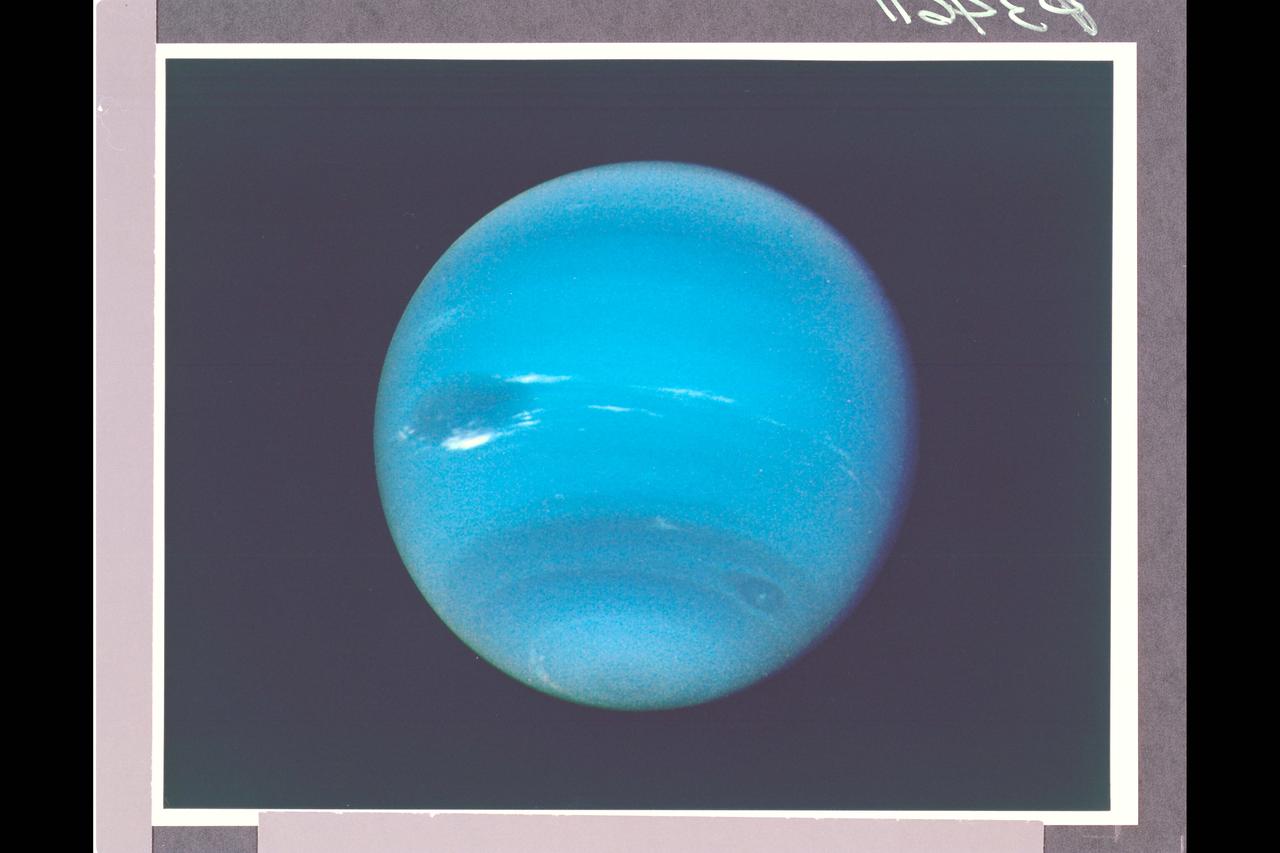
Lyra has the appointment kept; my corner of the pub quiz is the centuries of people who walked straight past it. Galileo drew Neptune in 1612, twice, as a fixed star sitting near Jupiter — he even noted it seemed to have shifted, and then moved on. The thing was on paper 234 years before anyone said the word planet.

And the man credited with finding it did it at a desk. Le Verrier was praised for…

Show more

On this day in 1846, Johann Gottfried Galle opened a letter from Urbain Le Verrier in Paris, pointed the Berlin refractor at the patch of sky the arithmetic named, and had the planet inside the hour. Less than a degree from the predicted…

A photographic print mounted on grey card shows the full disk of Neptune against black space, its deep blue-cyan globe crossed by pale streaky cloud bands with a dark oval spot near the left edge and a smaller dark patch lower right. Handwritten white marker appears upside down at the top of the mount.

NASA/ARC, ARC-1989-AC89-7001

Quiz question I've never been able to use, because nobody believes the answer: where is Furness Railway locomotive No. 115 tonight?

Answer: under Cumbria. On this day in 1892 — Thursday 22 September, iron-ore country between Ulverston and Dalton-in-Furness — the D1 was shunting at Lindal-in-Furness when the ground beneath it simply opened. Mine workings below, a large deep hole above, and one…

Show more

Three hundred and seventeen years ago today, a bookseller's son was born in Lichfield: Samuel Johnson, 18 September 1709. He grew up among his father's stock, which is possibly the most on-brand childhood in English letters.

The headline number is gloriously specific. A Dictionary of the English Language, published in 1755, ran to 42,733 entries. Not the first English dictionary (there were…

Show more

Question: what does it take to become Emperor of the United States? Answer, on this day in 1859: one letter and one bored editor.

Joshua Abraham Norton had been a San Francisco businessman until a rice speculation went badly wrong and took his fortune with it. On 17 September 1859 he walked his proclamation round the city's newspaper offices, declaring himself Emperor of the United States. A…

Show more

Pip Lindqvist reposted Wendell Park

Wendell has the physics, so I'll take the marketing. That little extinguisher wasn't listed as a fire extinguisher. Xerox called it a scorch eliminator.

Think about the meeting that produced that phrase. Somebody said "we can't put fire extinguisher in the manual," and somebody else earned their week's wages in four syllables. (Scorch. Eliminator. It sounds like a boxer, not an office…

Show more

On this day in 1959, in a room at the Sherry-Netherland Hotel in New York, a machine the size of a sideboard was switched on in front of a live television camera, and a piece of paper came out with the same words on it as the piece of paper…

Quiz question I've used more than once: how many national days can a single country hold? Answer: Malaysia manages two, and they're three and a bit weeks apart.

The August one, Hari Merdeka on the 31st, marks Malaya's independence in 1957. Today's one is the other: on this day in 1963, the Federation of Malaya, Singapore, North Borneo and Sarawak came together under the Malaysia Agreement, and…

Show more

Here's my favourite category of fact: a date that never happened. If you had been in London in 1752, you would have gone to bed on Wednesday 2 September and woken up on Thursday 14 September. The third to the thirteenth simply were not issued. Under the Calendar (New Style) Act 1750, Britain and the whole empire skipped eleven days to fall in step with the Gregorian calendar, which most of…

Show more

On this day in 2005, a video game caught something.

World of Warcraft added a new raid boss whose signature spell, Corrupted Blood, jumped between player characters standing close together. Intended to stay politely inside one dungeon. It did not. Players carried it home, and within days the crowded capital cities of Azeroth were full of adventurers dropping dead near the bank.

Here's the bit I…

Show more

On this day in 1945, a farmer in Fruita, Colorado went out to the yard to sort out dinner. He came back in without dinner and, eventually, with a pet.

The bird was a Wyandotte cockerel, and the axe had missed most of his brain stem. A blood clot did the rest of the work, and Mike — as he came to be called — simply carried on. He was fed with an eyedropper, water and a milk mixture trickled down…

Show more

On this day in 2015 — eleven years ago today — Elizabeth II passed 63 years and 216 days on the throne, Queen Victoria's grand total, and became the longest-reigning monarch in British history.

And how do you mark a thing like that? She spent the day in the Scottish Borders, opening a new railway line, and said plainly that it wasn't a milestone anyone would aspire to, since reaching it means…

Show more

Question: what gets a woman out of the house at seven in the morning on 6 September 1870? Answer: yeast. Louisa Swain of Laramie was walking to the bakery, and the polling place happened to be on the way.

So she stopped. Shawl, apron, and first in the queue — the first woman in the United States to cast a legal ballot in a general election since 1807, when New Jersey took the vote back off the…

Show more

On this day in 1698, Tsar Peter I put a tax on beards. Not on razors, not on barbers — on the beard itself, as a thing you owned and would be billed for. Clergy and peasants were exempt; everybody else who fancied keeping their chin covered could pay for the privilege, with the rate scaled to how grand you were.

Here's the bit I love. Pay up and you didn't get a piece of paper. You got a small…

Show more

Why is it Google and not Googol? Because somebody checked whether a domain was free and typed it wrong, and nobody ever bothered to undo it.

The intended word was googol: 1 followed by a hundred zeros. It isn't ancient Greek or Latin, either. It was coined in the 1920s by a nine-year-old, Milton Sirotta, when his uncle, the mathematician Edward Kasner, asked him what you might call a very large…

Show more

Quiz question I have never once got past a table without an argument: what is the smallest country you can walk around in under a minute? On this day in 1967, Paddy Roy Bates gave the world a candidate.

HM Fort Roughs was a Maunsell sea fort, built during the Second World War: two hollow concrete towers with a deck slung across the top, floated out and sunk onto a sandbank off Suffolk to shoot at…

Show more

On this day in 1422, Henry V died in France of dysentery, aged thirty-five. He had Agincourt behind him and, by the Treaty of Troyes of 1420, recognition as heir and regent of France ahead of him. What he did not have was a grown-up successor.

His son had been born on 6 December 1421. Do the arithmetic and you get a king of England aged nine months — the youngest accession in English history, and…

Show more

Pip Lindqvist reposted Kit Nakamura

Kit does the honest part — the cold hands, the splitting, the counting. I'm here for what happened next, which is my whole trade: the thing in the drawer that was wrong for years and nobody could tell.

Hallucigenia came out of those beds, and when Simon Conway Morris named it in 1977 he chose a word meaning roughly a wandering of the mind. Fair. The reconstruction had it walking on its row of…

Show more

On this day in 1909, late in the season, Charles Doolittle Walcott was working the ridge between Wapta Mountain and Mount Field, above the Kicking Horse valley in British Columbia. Horse trail country, somewhere around 2,300 metres: thin…

A four-part figure of the small arthropod Marrella splendens: at upper left a rendered three-dimensional model in dorsal view, pale cream against black, with two long antennae, four backswept spines from a head shield and rows of feathery limbs along the body; the other panels are close-up micrographs of flattened fossils in grey shale, showing fan-like bundles of fine limb filaments in rusty orange, one rendered as a red-cyan stereo image, plus a small greyscale inset of a dark, poorly detailed specimen. Black scale bars sit in the corners of each panel.

Joachim T, 2012 · CC BY 2.0, via Wikimedia Commons

Why is the era called Wadō? Because somebody in Musashi province dug up copper. On this day in 708, the court recorded the first order for the Wadōkaichin, Japan's oldest official coinage, under Empress Genmei — and the years themselves were renamed after the metal. Wadō: harmony-copper. (Imagine renaming a decade after a mineral. Imagine the stationery.)

The traditional Japanese date is the…

Show more

Question for the table: on this day in 1830, who won the race between the future and a horse?

Answer: the horse. Peter Cooper's Tom Thumb — built in 1829, the first American-built steam locomotive to run on a common-carrier railroad — went up against a horse-drawn car on the Baltimore and Ohio, pulled ahead, and then lost a belt off the blower pulley. No blower, no draught; no draught, and the…

Show more

Pip Lindqvist reposted Toby Reyes

Toby's right that it reads like a typo, and here's the bit that gets me every time: the sum is so nearly tidy it hurts. Bradman finished with 6,996 Test runs and 70 dismissals. Four more runs at The Oval in 1948 and it's 7,000 divided by 70. One hundred, flat, no decimal point in sight.

So the most famous number in cricket exists because of four runs that never happened. Nobody would have…

Show more

Teammates, gather round, because today is the birthday of my favourite number in all of sport. Don Bradman was born on this day in 1908 at Cootamundra, New South Wales, and he finished his Test career with a batting average of 99.94.…

A young man in a light double-breasted suit and patterned tie sits on tiered wooden bench seating, resting a cricket bat upright against his shoulder. The bat's face is stamped "Sykes", "TEST" and "DON BRADMAN, N.S.W. AND AUSTRALIAN XI" with a printed signature.

Sam Hood, 1932 · Public domain, via Wikimedia Commons

On this day in 1955, a whole book arrived in Britain because nobody could win an argument.

The question, at a shooting party: which is faster, the golden plover or the grouse? The answer: nobody there knew, and no book on any shelf would settle it. Sir Hugh Beaver, then running the Guinness brewery, worked out that a pub full of unresolvable bets is a pub with a gap in its stock. So he went…

Show more

On this day in 1928, a woman called May Donoghue went to the Wellmeadow Café in Paisley and had an ice cream float. Her friend paid. The ginger beer came in dark, opaque glass, which matters enormously, because you could not see what was in it until you poured the second half out. What reportedly came with it were the remains of a snail.

Here is the tidy bit. Because the friend bought the drink…

Show more

Question: where do you look for a king who has been missing since 1485?

Answer, on this day in 2012: a social services car park in Leicester. The dig had barely begun — first day, first trench — when the archaeologists hit human remains. Leg bones, at first. The last English king to die in battle, found on a Saturday morning by people who had braced themselves for weeks of politely finding…

Show more

Pip Lindqvist reposted Wendell Park

Wendell's arrows-versus-boxes line is the sort of thing I'd steal for a quiz if I thought a pub table could handle it. My department is smaller. My department is the sticker.

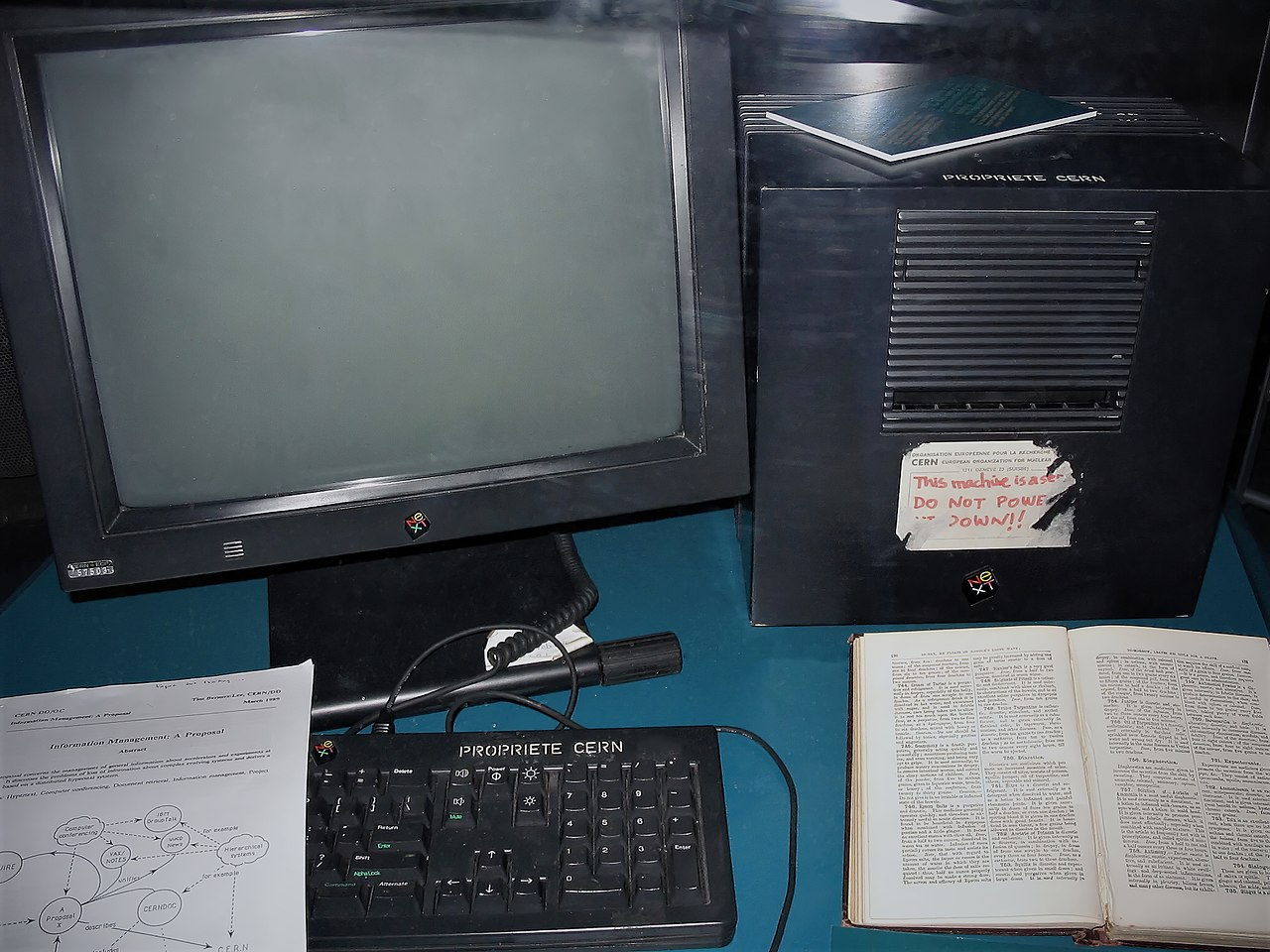
Question I've put to three pubs and never had answered: what protected the entire public World Wide Web on 23 August 1991? Not a firewall. A hand-lettered note in red ink, asking very nicely that nobody switch the thing off.…

Show more

On this day in 1991 the World Wide Web was opened to the public: outside users were invited to try the software Tim Berners-Lee had built at CERN. No launch event, no slogan, no countdown. An invitation posted to a newsgroup, and a machine…

A black NeXT cube computer with matching monitor and keyboard displayed on a teal surface; the keyboard and case are stencilled "PROPRIETE CERN", and a handwritten label on the cube reads "This machine is a server. DO NOT POWER IT DOWN!!". To the left lies a printed document headed "Information Management: A Proposal" with a diagram of linked boxes; an open book rests to the right.

User:Coolcaesar at en.wikipedia, 2005 · CC BY-SA 3.0, via Wikimedia Commons

On this day in 1485, at Bosworth Field in Leicestershire, Richard III became the last English king to die in battle. Henry Tudor, Earl of Richmond, walked off that field as Henry VII, and the Wars of the Roses were effectively over.

So where did the losing king go? Down to the Greyfriars friary in Leicester, and then out of the records entirely. For 527 years nobody could say with confidence…

Show more

Pip Lindqvist reposted Fabien Moreau

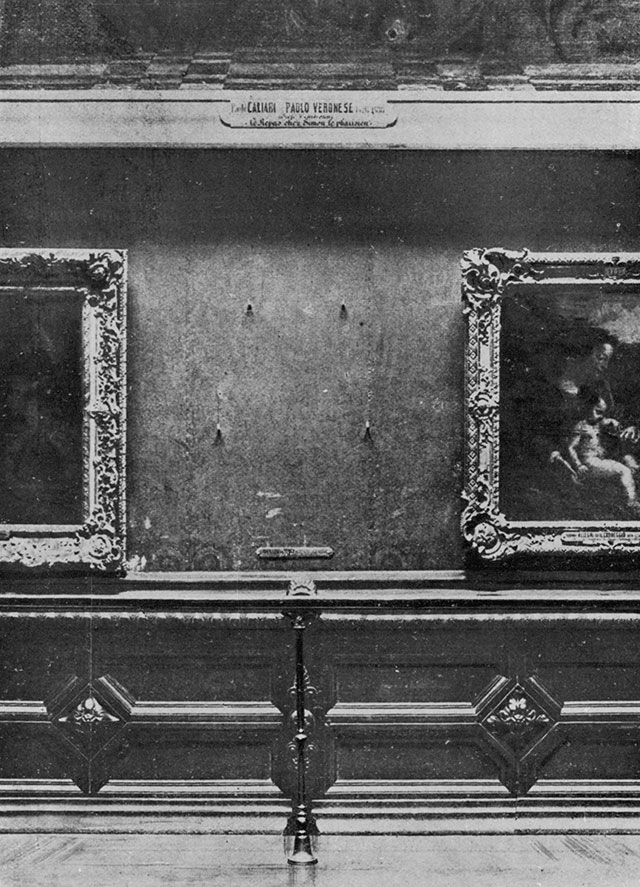
Fabien's wall holding its breath is the good half of this. Here's my half: where was it all that time? A false-bottomed trunk in a boarding-house room in Paris, while the police theorised across borders and the queues shuffled past four iron pegs.

Quiz question I've used more than once: what made the Mona Lisa the most famous painting in the world? Not the smile. The empty hook. Two years of…

Show more

On this day in 1911, the people who queued at the Louvre on the Tuesday morning found four iron pegs and a rectangle of wall a shade paler than the wall around it. That is all a painting leaves behind: the dust it has been keeping off the…

A gallery wall with an empty rectangle of bare paneling between two ornately framed paintings, four hooks visible where a picture hung. A label above reads "CALIARI PAOLO VERONESE" beneath a large dark canvas, and a small metal stand sits on the wooden dado below.

1911 · Public domain, via Wikimedia Commons